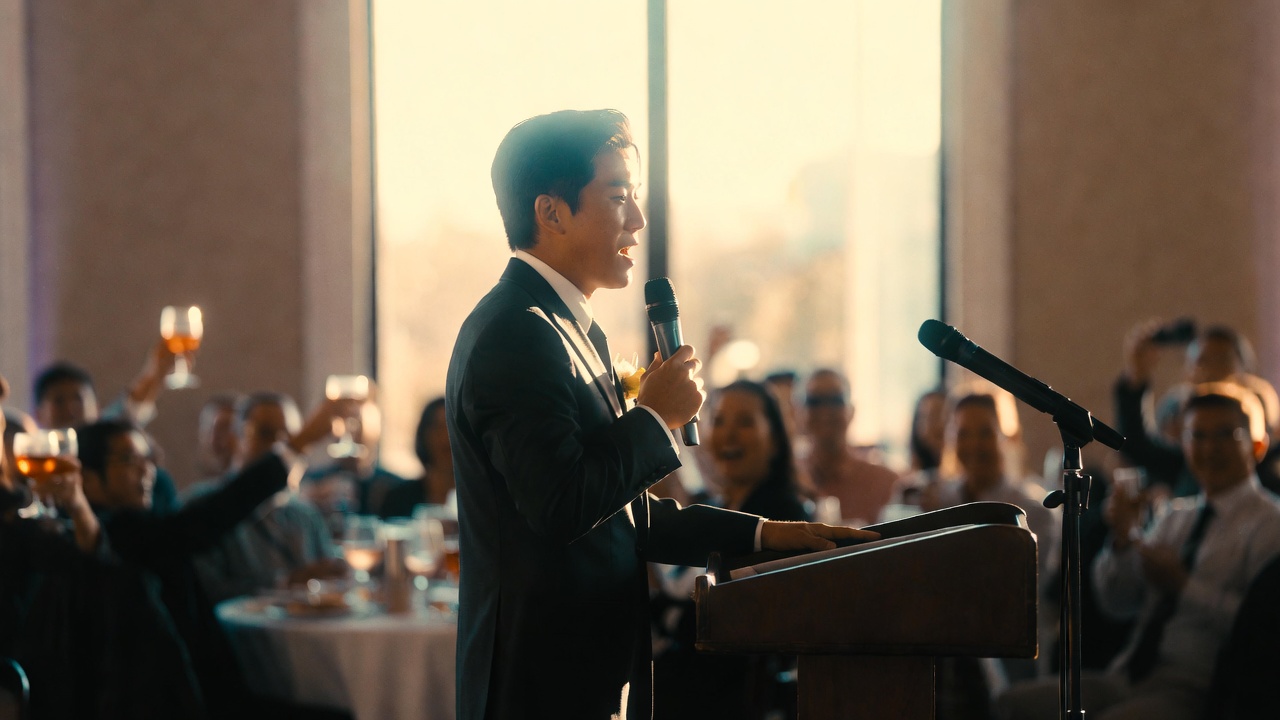
A best man speech for brother in law has a job blood-relative toasts do not: you have to welcome a man you did not grow up with without turning the mic into a family interview. The room already knows you belong to the other side of the aisle. Your minutes have to prove you see who he is now — and why the person sitting next to him chose well.
This guide is the in-law path: which stories to pick when you do not share a childhood, how to skip the loyalty test, and lines you can adapt. For a full outline first, use this guide to writing your speech. For complete drafts in other voices, keep our best man speech examples collection nearby after you lock this room's rules.
What a Brother-in-Law Toast Has to Prove
You do not need a biography of how you met. You need two minutes that show character in this chapter. Guests did not come for a recap of every holiday you have shared, or a speech that sounds like you are still deciding whether he passed. They came to hear why this person, this partner, this day deserves a glass in the air.
Name the relationship once. Then retire the gate. A great brother-in-law speech treats him as family you chose to stand up for — not as a visitor still on probation. Pride is fine. A public loyalty test is not. If a line only works because it reminds him you were here first, it is a family joke, not a wedding toast.
How to Structure a Best Man Speech for Brother in Law
Four beats are enough. Who you are, and how you are related. One story that shows who he is when nobody is scoring him. One story that includes the person he is marrying — often your sibling — so the toast is about the marriage, not the in-law interview. A close that names both of them. Write the toast first so the middle has somewhere to go.
"I am [Name], and I have the unusual honor of being both family and best man. The room already knows I did not grow up with him. Tonight I am here because I got to watch the version of him that showed up — and the person who already knew how to love it."
Aim for four to six minutes. If you are over seven in rehearsal, cut a getting-to-know-you bit before you cut the close. If you want a skeleton after this, template structures for your toast will hold the same beats without the family lecture.
Stories When You Did Not Grow Up Together
Pick two scenes, not six. You do not have a childhood archive with him, and the room does not need you to invent one. One story that shows who he is when the family is not watching. One that includes his partner — a Tuesday, a quiet kindness, the first time you realized you were no longer the main adult in the room. Keep each under a minute. End both on them, not on you.
Good brother-in-law material: the way he talks about your sibling when they are not listening, the patience he showed a parent, the night he showed up without being asked, the first holiday he stopped looking like a guest. Weak material: a tour of how hard you were to impress, a scoreboard of who is more loyal to the family, or anything that makes his partner feel like they married into a committee. If the draft wants to go tender, study emotional best man speeches for specificity, then come back and cut the interview.
"The year he started showing up without being asked, I stopped seeing the man who married into this family and started seeing the one who already belonged. Then I watched how he talks about [Partner] — first, and without a speech attached."
Humor, Loyalty Tests, and What to Leave Out
You can tease him once if the punchline is a habit he still owns — lateness, a stubborn playlist, the way he overpacks — and his partner is not the target. A tour of every time you were hard on him is a speech for a different room. Recover in one sentence that names why the habit was actually loyalty. Then get back to the couple.
Do not give him a public assignment to take care of your sibling. Do not list what the family paid for. Do not compare him to anyone who dated here first. Do not spend a minute explaining how long it took you to like him so the room will applaud your growth. If you hesitate, it is already gone. If you need a cleaner first and last line after you cut, best man speech openings will keep the speech from wandering back into a loyalty test.
Example Lines You Can Adapt
Steal the shape, not the family history. Swap the names and the one true fact. Keep the brackets as prompts, not as lines you read. If a blank stays generic after you fill it, cut that sentence. Keep his partner in the last third so the speech becomes a wedding toast instead of an in-law tribute.
"Good evening. I am [Name], [sibling] of [Partner], and tonight I have the honor of standing as best man for [Groom]. I did not grow up with him, which is a polite way of saying I had to learn him the ordinary way — by watching. I saw it in [one true scene that shows his character]. I see it now in how he talks about [Partner] — first, and without a speech attached. [Groom], thank you for loving this family without needing a glossary. [Partner], thank you for choosing someone who already looked like home. Please raise a glass: to my brother-in-law, to [Partner], and to a marriage that already knows how to choose the next ordinary Tuesday."
If he is quieter than this sample, shorten the praise and keep the stories. If humor is your natural voice, let one line tease a habit he still owns and let the last three stay sincere. Do not add a fourth getting-to-know-you bit after the toast because the emotion is still running. If children, parents, or old friends need a nod, give them one true sentence before the close — then stop adding chapters.
Close on the Couple, Not the Family Gate
End on them, not on how long it took you to approve. One sentence to him. One sentence to the person he is marrying. One raised-glass line the room can repeat in their heads. Then stop. The most common brother-in-law mistake is adding a welcome-to-the-family footnote after the toast because the emotion is still running — one more take-care-of-her, one more I-had-to-be-sure.
If the venue is tight, check short and meaningful toasts and cut a getting-to-know-you bit before you cut the close. Practice the last thirty seconds until you can look up. Print large type. Mark a breath before the toast. A best man speech for brother in law lands when he feels chosen, his partner feels seen, and nobody has to clap for your approval. That is the whole job.
Frequently Asked Questions
How do I start a best man speech for my brother in law?
Introduce yourself as family and best man in one clean sentence, then move into a story from this chapter. Skip the recap of how long it took you to like him. The room already knows you belong to the other side of the aisle. They need a reason to listen to you about the man he is now and the person he is marrying.
What should I avoid in a best man speech for a brother in law?
Avoid a public loyalty test, a take-care-of-my-sibling assignment, and any line that keeps him on probation in front of both families. Do not compare him to anyone who dated here first. Do not spend a minute explaining how hard you were to impress so the room will applaud your growth. One affectionate tease is enough if the punchline is a habit he still owns.
How do I write a best man speech if I did not grow up with the groom?
You do not need childhood stories. Pick two adult scenes: one that shows his character when the family is not watching, and one that includes the person he is marrying. Keep each under a minute and end both on them. Specific Tuesdays beat a highlight reel of every holiday you have shared.
How long should a best man speech for a brother in law be?
Four to six minutes is the sweet spot. That is enough time for two stories and a toast. If you are over seven minutes in rehearsal, cut a getting-to-know-you detail before you cut the close. Guests came for this marriage, not a family interview.
Can I use a template for a brother-in-law best man speech?
Yes. Steal the shape, not the family history. Fill in one true scene that shows his character, one scene that includes his partner, and a toast that names both of them. If a blank stays generic after you fill it, cut that sentence. The room can hear a template. They cannot hear a specific fact.